
Cooper City Historical Collections
Cooper City was incorporated in 1959 on land formerly known as Wacico Groves. That date controls the shelf search. Material before incorporation may be filed under Davie, Fort Lauderdale, Broward County, or Dade County, the predecessor jurisdiction before Broward was formed in 1915. Later telephone and suburban Broward volumes may include Cooper City even when the catalog title does not name it. No official catalog page identifies a complete, standalone Cooper City publisher run, so a careful search confirms each volume’s geographic scope rather than assuming it.
| Historical source | Coverage | Custodian | How to use it |
|---|---|---|---|
| Florida resident directories | Early 1900s to present; exact local volumes not listed online | State Library of Florida | Onsite research, catalog inquiry, or reference help |
| Broward Digital Archives | Collection dependent; Sun-Tattler West includes a 1985 example | Broward County Library | Free online name, club, obituary, and address context |
| Historical Archives | Dates vary by finding aid | Broward County Library Special Collections | Finding aids, papers, photographs, government files, oral histories |
| Genealogy databases | Database dependent | Broward County Library branches | In-branch Ancestry Library Edition; Fold3 subject to library access |
| Federal census | 1790 through 1950 currently public | NARA and library databases | Household snapshots; the 1960 census opens in 2032 |
The State Library’s Florida directory collection is the best first contact for a title search. Staff can be reached at 850-245-6682. Ask for the title page, year, publisher, and coverage statement. Those four details prevent a regional volume from being mislabeled as a Cooper City-only book.
The State Library page shows the collection and its reference route. Its screen is preserved here as a practical starting point.
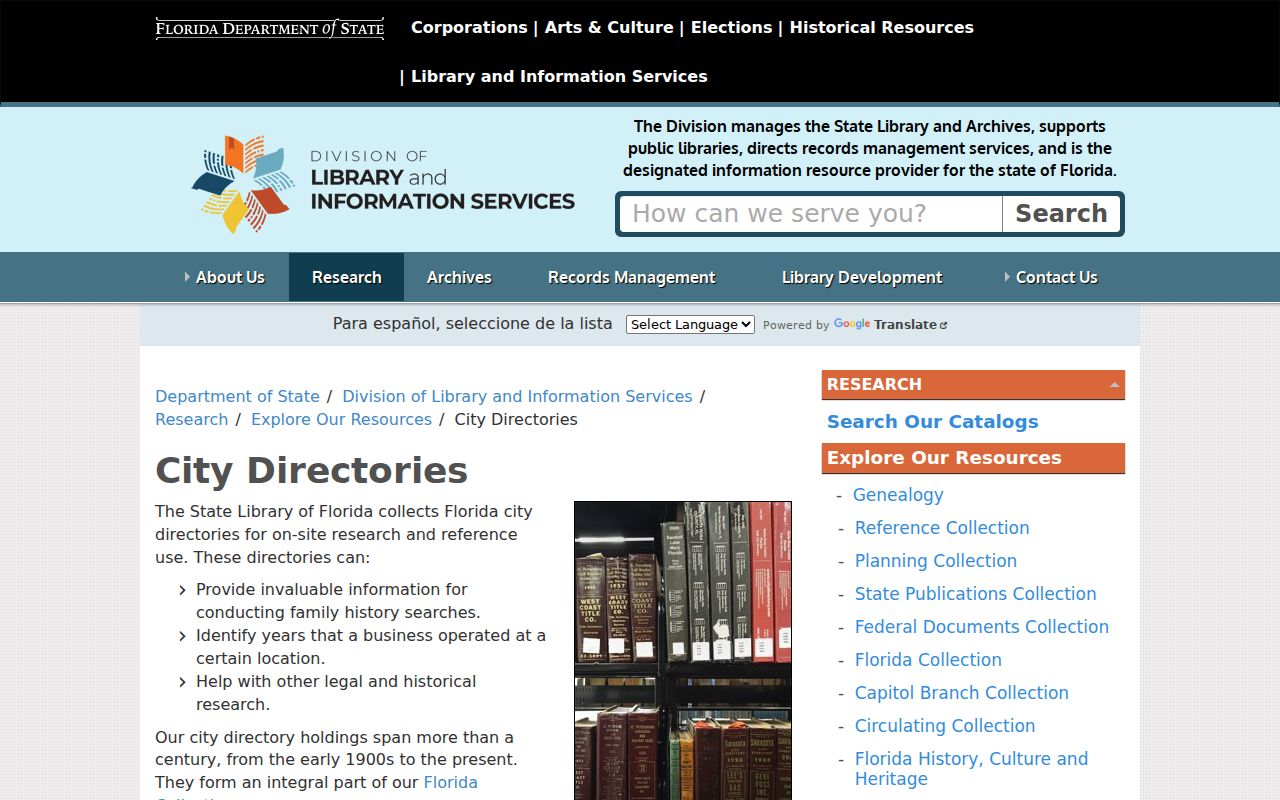
The catalog and reference desk should be used to verify an actual volume before any year-specific claim is made.
Periodize Cooper City Searches
A name from before 1959 should not be searched only under Cooper City. Use Davie, Fort Lauderdale, Broward, and, for early county history, Dade as alternate place terms. Add Wacico Groves when the family or parcel connects to the citrus land that preceded the city. For later years, ask whether a suburban Broward or telephone volume included the new municipality and whether it had a separate Cooper City heading.
Three local changes help place a source in time. Cooper City began with 85 residents and 35 finished homes at the end of 1959. Broward records show the county boundary context from 1915 onward. Road references also changed: early maps used Morris Cooper Boulevard for 90th Avenue, Griffin Road carried the nickname Halloween Road before paving in 1963, and Stirling Road reached 100th Avenue, also called Palm Avenue, in 1967.
Cooper City Archive Shelf
The Broward Digital Archives is not a substitute for a printed directory, but it fills gaps left by a thin suburban shelf. The Sun-Tattler West carries Cooper City neighborhood, civic, religious, and club mentions. A 1985 page includes a religious survey, Girl Scout registration, and Davie/Cooper City Library programs. Such notices can place a family between editions or explain an address that appears only once.
The archive interface below shows where digitized newspapers, photographs, oral histories, government collections, and other local sources can be searched.
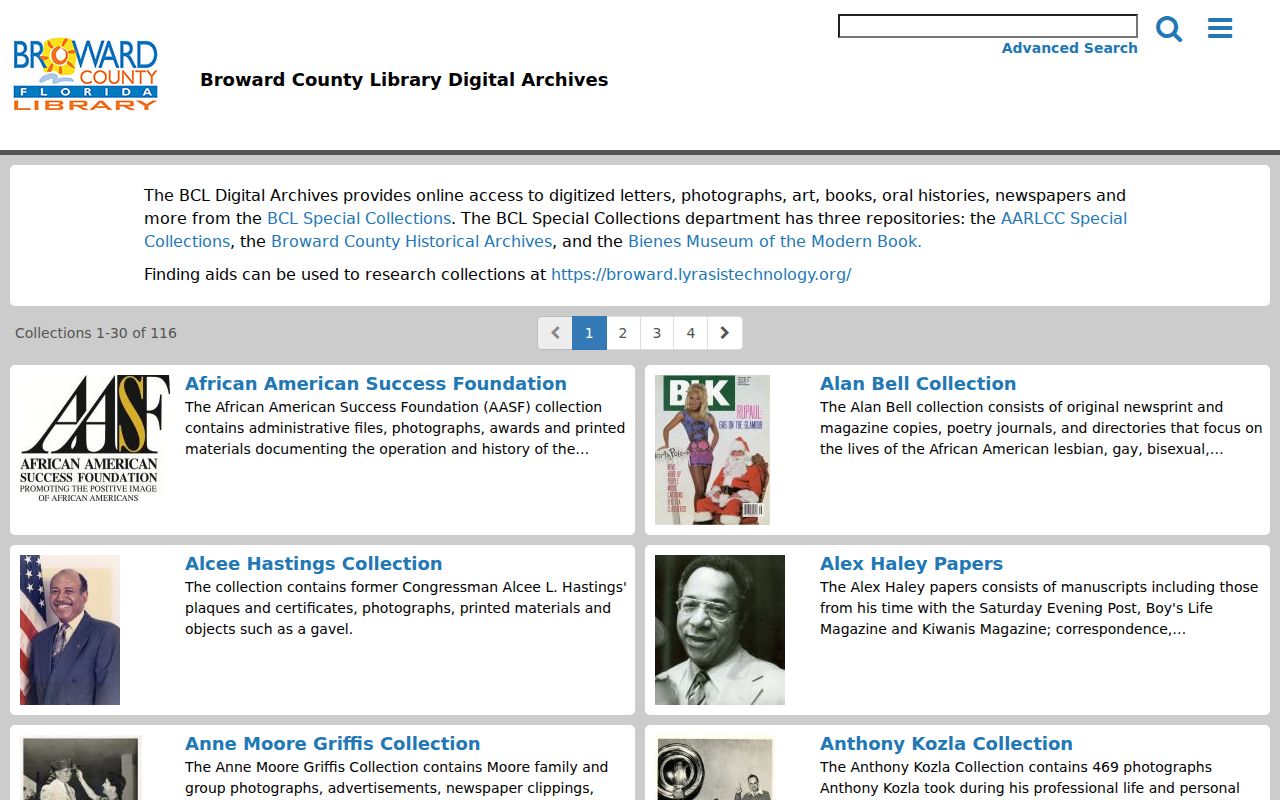
Record the newspaper title, date, page, and search spelling with each match. Broward oral histories also reach memories from the 1890s and can preserve old roads, family names, and businesses that never appeared in a formal directory.
Read Cooper City Listings
A typical Florida directory entry can list a surname and given name, a spouse in parentheses, occupation or employer, home address, telephone number, and short status marks. This is a standard reading method, not a transcription from a verified Cooper City volume. Publisher styles differ, so the key printed in that same book controls the meaning.
| Personal name | Surname, given name, and sometimes a spouse in parentheses |
|---|---|
| Work line | Occupation or employer as printed, often in abbreviated form |
| Home line | Street address and telephone number when listed |
| Status marks | “h” may mean householder, “r” may mean resides or rooms, and “wid” means widow |
| Street entry | A reverse section may list the house number, occupant, and telephone |
- Criss-cross directory
- A directory ordered by street and house number instead of surname.
- Householder index
- A list centered on the person associated with a home, which may omit other people there.
- Abbreviation key
- The publisher’s own list of short forms and symbols, usually near the front of the volume.
Copy the entry exactly before interpreting it. Photograph the key and title page too. A letter guessed from memory can turn “rooms” into “resides,” and a familiar employer abbreviation may mean something else in another publisher’s book.
Cooper City Library Research Routes
The Davie/Cooper City Branch Library is the nearby branch, but the countywide research tools matter most. Ancestry Library Edition is available inside Broward County Library branches. Fold3 includes military, naturalization, and city-directory material under its access terms. Eligible users may reach Digital Sanborn Maps through the Nova Southeastern University e-card relationship, though no Cooper City-specific Sanborn sheet was verified.
For deeper work, ask Broward Historical Archives and Special Collections to check finding aids and suburban directory holdings. Main Library reference is 954-357-7444. Obituary requests can be sent to periodicals@broward.org, but staff warn that not every local death appeared in searchable news.
The Cooper City early-settlers account gives the local names and Wacico Groves context needed to frame an archive request.
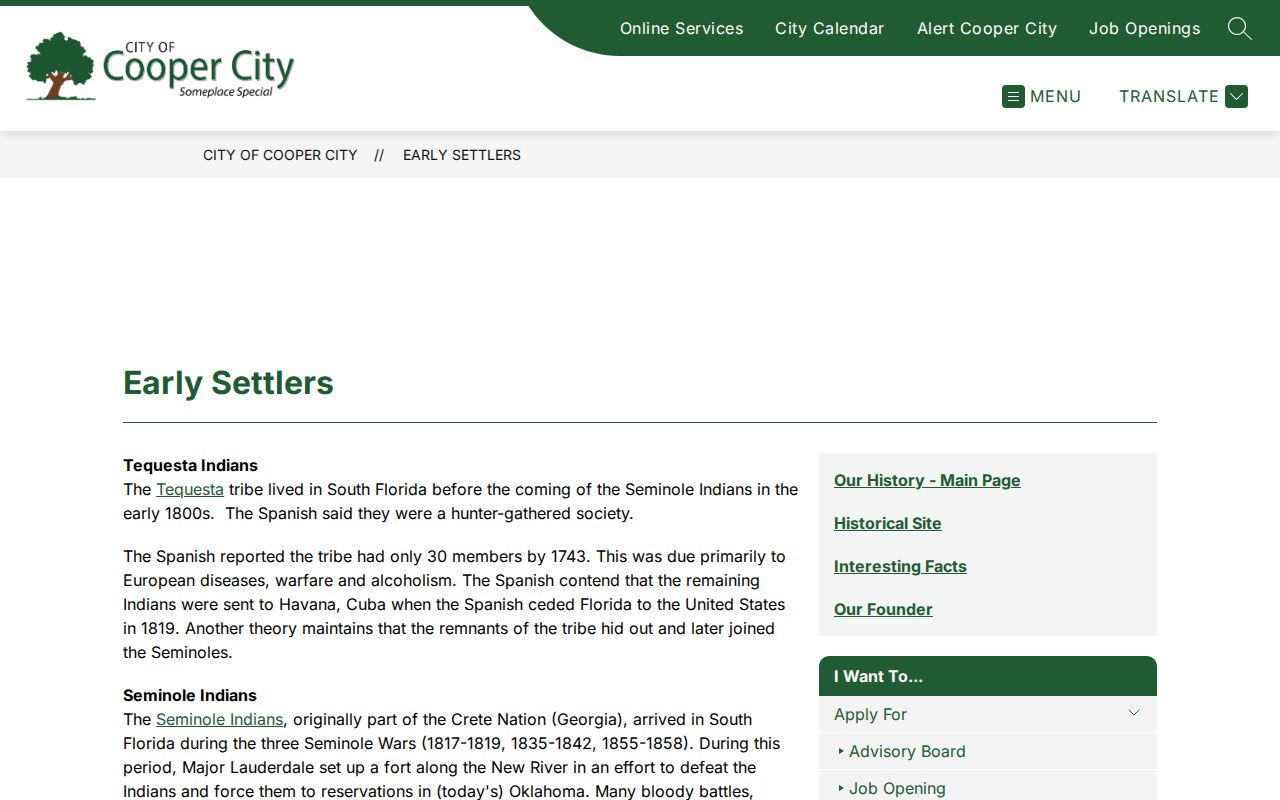
That official history helps separate a founding family, developer, or lot buyer from a later listed household.
Cooper City’s One-Phone Problem
For months after Cooper City was founded, the only residential telephone was reportedly at the home of a telephone-company employee, Mr. Beauer. That small fact changes how an early telephone book must be read. A household missing from the book may still have lived in the new community, while a listed number may have served as an unusual point of contact.
The city’s historical facts provide more context on Cooper City’s first years, public buildings, streets, and civic growth.
The lesson is plain: directory absence cannot prove absence from Cooper City, especially during the city’s founding period.
Reverse Cooper City Address Searches
An alphabetical directory answers “where was this person listed?” A reverse or criss-cross section answers “who was listed at this address?” Search the printed street name and house number, then compare nearby numbers. Do not assume a telephone book includes this feature. Ask the librarian to confirm both an alphabetical resident section and a reverse street section.
Old road forms matter. Search both 90th Avenue and Morris Cooper Boulevard. Include the subdivision, lot and block when possible. If the aim is a current address chain, the Cooper City street directory explains the modern parcel route; historical volumes remain the right tool for printed occupants and phone listings.
Note: A directory entry shows what the publisher captured, not a complete legal roll of every person at the address.
Trace Cooper City Family History
Historical directories can bracket a move, link a spouse, and put a family near a known street. They work best as a sequence, not as isolated hits. Begin with a verified regional volume, preserve its exact wording, then add records made for a different purpose.
- Establish the parcel’s legal identity through the Broward Property Appraiser folio and deed chronology.
- Choose a directory that covers suburban Cooper City or Davie, and read its front matter before searching.
- Check the surname section and reverse street section. Copy spelling, spouse, occupation, and symbols exactly.
- Repeat the search in the next available volumes. Treat appearance and disappearance as a date range, not an exact move date.
- Pair pre-1950 area research with the public 1950 census. Pair later entries with deeds, newspapers, and permits after May 1993.
- Close the trail with an obituary request, oral history, or archive file, then cite each source separately.
A vanished name may mean a move, death, unlisted phone, changed surname, missed canvass, or a boundary shift. Check the prior and following volumes, then use an obituary, deed, or census record to test the likely cause. Current verification belongs in the Cooper City resident lookup, not in a historical directory claim.
Keep a citation for each volume that includes its exact title, publisher if shown, year, page, repository, call number, and access date. For a digital scan, save the image number as well as the printed page. If staff checked an uncataloged suburban run, note the collection name and box or reel. This discipline matters in Cooper City because a Fort Lauderdale, Davie, Broward, telephone, or reverse volume may include the city without naming it in the main title. It also makes a later finding easy to verify when a shelf moves or a database changes.
Finish by separating fact from inference. A printed name at an address proves what that publisher captured for that edition. A deed proves a recorded transfer. A census schedule identifies a household at its enumeration date. A newspaper may document a social or civic tie. When all point to the same person and place, the family-history conclusion is much stronger than any city directory entry alone.