
Finding Cooper City Residents
Start with the record keyed to what is known. The Broward County Property Appraiser, or BCPA, accepts an owner name, street address, folio, subdivision, or sale detail. It is the best first stop for a house because it connects the situs address to the owner, tax-mail destination, legal description, and deed links. A name search can then move to the Broward voter lookup, Clerk case search, Sunbiz, or a professional license portal. For older Cooper City residents, use deeds, newspapers, probate, obituaries, and directory collections.
One match is not enough. An owner may live elsewhere, a voter record may be stale, and a business filing may use an office address. Match two stable facts such as a full name plus folio, address, spouse, case number, or document number. The Cooper City residents directory is a route through those records, not a claim that every occupant appears in an official roll.
When only a phone number is known, begin with records the person or organization chose to publish, then confirm the name in an official index. A disconnected number and an old mailing address are weak evidence. When only an old street is known, normalize the house number and street name before searching modern parcel data. Keep a simple worksheet with the exact spelling, date, source, record identifier, and what the record truly proves. That habit prevents two same-name people from being merged.
- Search BCPA by owner or address and save the folio, legal description, and deed reference.
- Check the identity-gated Broward voter lookup when the person can supply the required details.
- Use the owner name or instrument data in Broward Official Records to locate deeds and liens.
- Check Broward Clerk records, probate, archives, and newspapers for a second identity anchor.
- Ask the correct custodian under Florida chapter 119 when the needed record is not online.
Cooper City Resident Record Keepers
Cooper City is not the county seat. Most core records are held in Fort Lauderdale by separate Broward offices. BCPA maintains parcel assessments. Records, Taxes and Treasury records deeds and plats, while the Clerk of Courts maintains cases, probate, and marriage licenses. The Supervisor of Elections controls voter access. Cooper City City Clerk handles municipal minutes, ordinances, correspondence, and other city files. Address research in the Cooper City street directory shows how those offices fit together street by street.
Each keeper offers a different fallback when a web page fails. The recording office has Search and Copy staff plus older film and images. The Clerk accepts court-record requests through online, mail, and in-person channels. Library reference staff can check databases and guide newspaper searches, while the City Clerk routes municipal requests to the right department. Bring a folio, instrument number, case number, exact date range, or legal description whenever possible. Those identifiers matter more than a broad request for all records about a person.
Broward Recording Office
115 South Andrews Avenue, Room 114
Fort Lauderdale, FL 33301
954-831-4000
Broward Property Appraiser
115 South Andrews Avenue, Room 111
Fort Lauderdale, FL 33301
954-357-6830
Broward Elections Office
115 South Andrews Avenue, Room 102
Fort Lauderdale, FL 33301
954-357-7050
Search Cooper City Parcels First
The BCPA record search turns a Cooper City address into a folio, owner name, mailing address, legal description, assessed values, exemptions, sales, and linked deed references. The situs field means the physical parcel address. It is distinct from the owner's mailing address. A homestead exemption is useful evidence of an owner's claimed primary home, but it does not list a spouse, child, renter, or other person in the household.
The BCPA Property Search is free and supports several routes. Broad street work is more reliable when the street type and direction are left out. Name results may include prior owners, so open the parcel record and compare the folio and legal description before moving to a deed search.
| BCPA mode | Useful input | Result to save |
|---|---|---|
| Owner | Last name or company | Owner and parcel match |
| Address | House number and street name | Situs, folio, legal description |
| Folio | Ten-digit identifier | Direct parcel record |
| Subdivision | Plat or subdivision name | Related Cooper City parcels |
| Sales | Date or price filters | Transfer history and deed links |
The official BCPA search screen shows the property portal used for this part of the Cooper City residents directory.
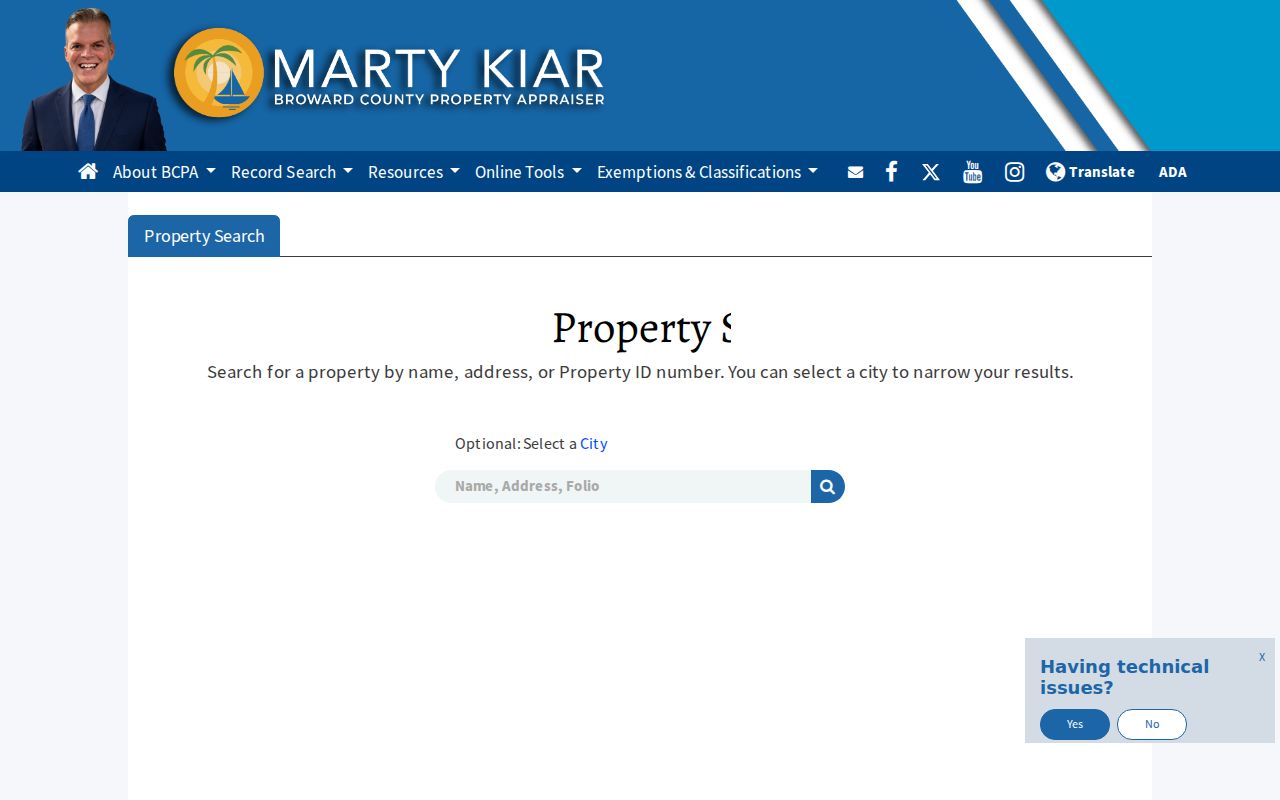
Its search choices make clear why the folio is the safest bridge between an address and county records.
A sample BCPA parcel can also show land and building values, tax-year history, exemptions, neighborhood code, use code, construction details, sale price, sale date, and linked recorded instruments. Read the assessment year before comparing values. Sale entries may include transactions that do not reflect an open-market move. The neighborhood field is more reliable for parcel grouping than an informal subdivision nickname, but the recorded plat and legal description remain the best boundary checks.
Cooper City Deeds Cross Decades
Broward Official Records carries Cooper City's full incorporated era, but online access changes by date. All plats and maps are searchable regardless of date. Limited instrument, book and page searching begins March 9, 1972. Fully searchable indexing begins July 7, 1977 at 1:47 p.m., and online deed images begin August 24, 1998. Earlier county media generally reach 1871, with ownership documents available since 1883, through the Search and Copy section.
Use the current owner's name, legal description, document number, or book and page from BCPA. In a deed, the grantor gives the interest and the grantee receives it. The index may show document type, recording date, parties, consideration, book and page, instrument number, legal text, and image access. A recorded deed proves a transfer, not who slept at the address.
Walk backward one transfer at a time. Open the newest deed, note the seller, and search that name as a grantee in an earlier range. Confirm each step with the same legal description because one owner can hold more than one Broward parcel. Mortgages, satisfactions, notices of commencement, judgments, and liens enrich the timeline but do not replace the deed chain. For Cooper City's first decades, take book and page references to the office rather than assuming a missing online name result means no document exists.
- Parcel
- A mapped unit of land with its own folio.
- Index
- A finding tool that points to a filed record.
- Roll
- An official list maintained for a public purpose.
- Criss-cross directory
- A printed directory arranged by address or phone rather than name.
The Broward Clerk Case Search is separate from the recorder, as its public party-search screen shows.
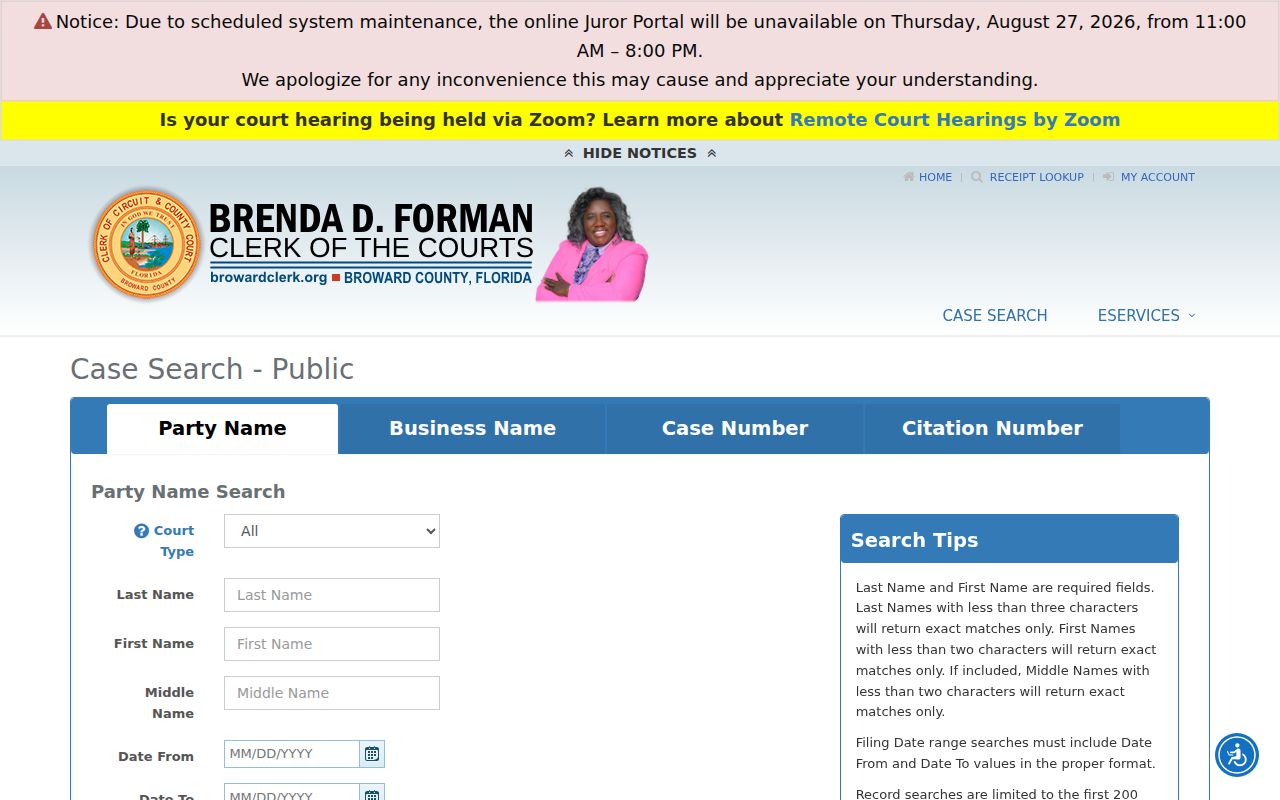
Keeping the Clerk and recorder roles separate prevents a common Cooper City records search error.
Current Cooper City Resident Rolls
Today's Cooper City residents directory is assembled from rolls made for different public tasks. Property records name owners. Voter data covers registered voters, with protected fields removed. Recorded documents name parties to transactions. Municipal files may identify an applicant, contractor, official, or person who wrote to the city. None is a census of every person at an address.
| Source | Who It Lists | Keeper | Access |
|---|---|---|---|
| BCPA property roll | Parcel owners | Property Appraiser | Free portal |
| Voter information | Registered voters | Supervisor of Elections | Identity lookup or data request |
| Official Records | Parties to recorded filings | Records, Taxes and Treasury | Online index and office media |
| Municipal records | Named parties in city files | Cooper City Clerk | Online or chapter 119 request |
| License and business rolls | Public professional and filing contacts | Florida agencies | Free state portals |
Choose the roll that matches the question. To confirm one name, use the Cooper City resident lookup workflow and demand two matching anchors. For a business connection, Sunbiz can show entity status, filing dates, registered agent, officers, and filing addresses. Those addresses are not verified homes.
Municipal minutes and advisory-board files identify people acting in public or civic roles. Permits can identify an owner, contractor, applicant, work description, issue status, and inspections. A code file may identify an owner or cited party. None should be stretched into a claim about a whole household. School directories and current membership lists are generally private, while a yearbook, donated church roster, or archived association file may be useful for lawful historical research if a library actually holds it.
Cooper City Voter Data Limits
The Broward Supervisor of Elections offers an identity-gated individual lookup rather than a public street browser. A registered-voter list request can supply public fields, but Florida law protects the source of registration, Social Security and driver-license numbers, preregistrant data, copied signatures, and qualifying protected addresses. Vote-by-mail information has added statutory limits.
The current Broward data-request route charges $20 per search. A USB costs $6 when needed, while large electronic files may arrive through Dropbox. The voter roll supports a Cooper City residents directory search only for registered voters who are not shielded. It cannot prove that every named person still lives at the filed address.
Public voter fields can include a voter's name, residence address, mailing address, precinct, party, registration date, status, and voter history, subject to exemptions and the exact request. Voter history shows participation, not a ballot choice. Use the current statute rather than an old summary because section 97.0585 changed in 2024. A geographic file may help count registered voters in a ZIP or street area, but it still cannot name children, noncitizens, unregistered adults, or protected participants.
The official Broward voter lookup is the correct verification point.
The login fields reflect why this service is not an open block-level directory.
Request Cooper City Records
Florida Public Records Law, chapter 119 and article I, section 24 of the Florida Constitution, gives access to nonexempt public records. Section 119.07 governs inspection, copies, reasonable time, and allowed fees. A request should describe an existing record, date range, office, address, or subject. The agency does not have to answer a research question or create a new report.
For municipal material, contact the Cooper City Clerk at City Hall, 9090 SW 50th Place, Cooper City, FL 33328, by the city's public-records route, email at Info@CooperCity.gov, or main line 954-434-4300. For deeds, court files, voter data, and assessments, send the request to the county office that actually keeps the record. Narrow requests reduce search time and special-service charges.
Ask for records, not answers. A useful request might seek commission minutes for a date range, an identified permit file, or correspondence concerning a named parcel. It should not ask staff to decide who lived at a home. Florida agencies may charge authorized copy costs and an extensive-use fee when clerical or technology work is substantial. Inspection must occur within a reasonable time, but the law does not set one universal response deadline for every request.
Lawful use. Use Cooper City records for legitimate personal research. Never use an address or identity detail to stalk, threaten, harass, or harm someone.
Cooper City Lien Search Details
Cooper City's municipal lien search is unusually broad for address history. A written request can return unpaid utility charges, formal and informal municipal liens, special assessments, City Code violations from the prior 12 months, and open building permits issued after May 1993. The response can connect a parcel to city activity that never appears as a simple entry in the property roll. A permit applicant or contractor is still not proof of who occupied the home.
The request is not an anonymous public portal. It must be placed on letterhead and include the requester's name, mailing address, email address, and the property's legal description. A self-addressed stamped envelope is required for a hard copy. Start in BCPA, copy the legal description exactly, and compare the final response to the same folio. This reduces mistakes caused by units, abbreviated street types, directionals, or similar postal addresses.
Code enforcement can also bridge city and county records. A municipal order may name an owner or violator, and a resulting lien may later be recorded in Broward Official Records. The June 2026 Ordinance 26-14 updated citation fines for several categories, including animal, parking, trash, noise, solicitation, property maintenance, fire code, and micromobility violations. Those cases may become part of later city files or lien research.
Note: Cooper City has no separate municipal court, so ordinance cases belong in the Broward and 17th Circuit record system.
Cooper City Court Name Checks
The Broward Clerk public Case Search accepts a party name, business name, case number, or citation. Party searches use short exact-name rules and return no more than 200 results, so a middle initial, date range, division, or case type can separate common names. Results may show the case number, parties, filing date, division, type, status, disposition, events, charges, docket lines, and available images.
A docket is the chronological list of filings and court events. It is not the same as the documents themselves. Some images are restricted, sealed, confidential, or available only through a records request, mail, an in-person terminal, or an authorized account. Probate is often the best court route for identifying heirs, personal representatives, and estate filings. Pair it with the Broward Library obituary service, which accepts requests at periodicals@broward.org.
Family cases need added care. Florida's Bureau of Vital Statistics can certify a dissolution report, but the Broward Clerk keeps the actual divorce case. Marriage-license records are also handled by the Clerk. A search result is only an index lead until the case number, party, date, and division all match. Federal cases involving a Cooper City name may appear through PACER and the Southern District of Florida, which covers Broward County, but federal access should be used only when the known event belongs in federal court.
Cooper City Heirs and Obituaries
Estate research works best when probate and obituary sources are paired. A Broward probate case may identify the decedent, personal representative, attorney, heirs, filing dates, and docket events. The court file may be available online, by records request, through the mail, or at a public terminal. Restricted images and sealed filings remain unavailable to the general public. Search name variants and a date range, then use the case number for a precise request.
Broward County Library accepts obituary-search requests at periodicals@broward.org and warns that not every local death appeared in a searchable paper. The Broward Digital Archives adds newspapers, photographs, oral histories, and county-government material. Sun-Tattler West is especially useful because its Cooper City pages include neighborhood, club, religious, and civic names that may never appear in a deed or property roll. Southeast Regional Newspapers covers 2008 to recent issues through ProQuest, with a three-month embargo.
Death certificates add a formal date and place, subject to Florida's cause-of-death limits. Funeral-home notices can supply relatives and chronology, while cemetery memorials should be checked against certificates or cemetery records. Together, probate and obituary sources provide a lawful path to an heir or family line without treating an owner's name as a full household list.
Cooper City Vital Record Boundaries
The Florida Department of Health keeps statewide birth, death, marriage, and dissolution certifications. Under Florida Statutes section 382.025, birth records remain confidential until more than 125 years old unless an authorized requester qualifies. Death records without cause are generally public, while cause-of-death details remain restricted for 50 years except to eligible people. State dissolution reports do not replace the full Broward court file.
The Florida vital-records hub supplies official forms and ordering routes.
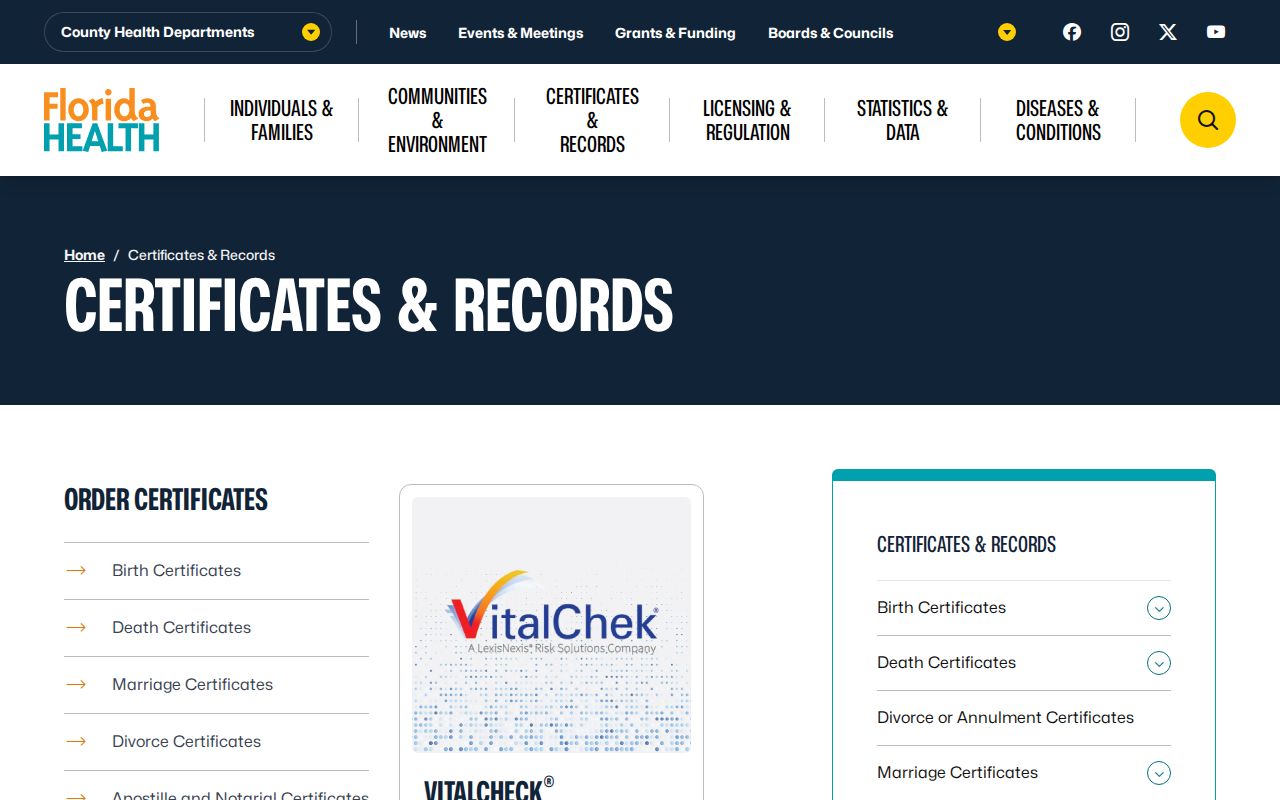
Use certificates to confirm life events after a name has been tied to the correct Cooper City household.
Historical Cooper City Directory Trails
Cooper City incorporated in 1959, so it does not have the long standalone directory run found in older cities. The State Library holds Florida city directories from the early 1900s onward, but its published catalog does not confirm exact Cooper City years or publishers. Broward telephone books, reverse directories, newspapers, deeds, and suburban county coverage may be more useful. The full collection strategy appears in the Cooper City city directory page.
Early research must also account for place names. The area was once Wacico Groves, and records before Broward County's creation in 1915 may be indexed through Dade County. Early maps used Morris Cooper Boulevard for today's 90th Avenue. Griffin Road was called Halloween Road, while 100th Avenue also appeared as Palm Avenue. Search each name variant in directories, newspapers, plats, and deed text.
Access depends on the collection. Ancestry Library Edition is available inside Broward branches, while Fold3 adds city directories, naturalization files, and military sources. Eligible Broward County Library users may obtain an NSU e-card for Digital Sanborn Maps and historical newspaper or oral-history databases. Broward Historical Archives provides finding aids for local heritage and government collections. The African American Research Library and Cultural Center holds regional family, community, and historic Black newspaper collections. Ask staff to verify a volume or year before planning a visit because no authoritative catalog confirms a Cooper City-only directory run.
Cooper City Business Identity Clues
Florida business and license portals can separate two people with the same name. Sunbiz searches entity names, officers, registered agents, document numbers, FEI or EIN values when public, and fictitious names. A detail page may show the legal entity name, status, filing date, state, principal and mailing addresses, registered agent, officer or manager names and titles, annual-report dates, and image PDFs. Those are filing facts, not a finding that an officer lives at the listed address.
The Department of Business and Professional Regulation covers many real estate, construction, cosmetology, food, and other regulated activities. Its records may show name, license number, location, status, and discipline. Florida Department of Health MQA records cover physicians, nurses, and other health professions. The Florida Bar and educator-certificate systems add role-specific checks. For Cooper City's suburban economy, property professionals, contractors, health practitioners, food establishments, and home-service businesses are useful categories.
Cross-check a filing address in BCPA only to learn who owns the parcel. A registered agent accepts legal service and may have no ownership link to the company. An annual report may also lag a move. A strong Cooper City residents directory match uses the entity's document number or license number plus a second source tied to the correct individual.
Cooper City's Small First Roll
Cooper City ended its founding year with 85 residents and 35 completed homes on Morris Cooper's former 691-acre Wacico Groves tract. By 1963, 120 homes had been built, though many stood empty. For months, the only residential telephone reportedly belonged to telephone-company employee Mr. Beauer. An early phone book could therefore miss most of the new community, while county deeds might show the developer, utility interests, and lot purchasers instead of settled households.
This local story is a useful warning. A blank directory entry does not prove that no one lived at a Cooper City address. Commission minutes, bond papers, early newspapers, utility records that are not confidential, deed books, and later reverse directories may fill the gap. Broward Digital Archives includes Sun-Tattler West pages with Cooper City civic, club, religious, and library mentions at least by 1985.
The city's planned growth also shaped the record trail. Morris Cooper invested heavily when the early 1960s market fell. Resident opposition cut the proposed 1962 municipal budget from $19,348 to $5,398, and Cooper later advertised the city for sale in the Wall Street Journal without finding a buyer. Commission, bond, utility, election, and newspaper records from that period can name public participants and property interests. They should be read as civic evidence, not as a complete resident roll.
Cooper City Lines Can Mislead
Postal city, ZIP code, and legal city limits answer different questions. Sunshine Acres and Rio Ranches were de-annexed in the early 1960s, and the city acknowledges parcels within the wider geographic area that are not legally part of Cooper City. A mailing line alone cannot select the correct tax, permit, code, or voting jurisdiction. Confirm the parcel in BCPA, then check its taxing authorities, subdivision plat, and city status.
The compact city covers 8.04 square miles. The Census Bureau estimated 35,030 residents on July 1, 2025, up from 34,401 in 2020. Those figures describe the city as a whole, not a searchable name list. Parcel records are productive in this largely residential place, but they still omit renters and many family members.
Growth occurred in waves from the original core through later subdivisions and western development. The city bought the privately operated water plant in 1983 after repeated voter rejection and issued $13.1 million in bonds. Volunteer fire service continued until 1986. Such dates help select sources: early homes call for deed books and newspapers, later parcels benefit from online deed images, and post-May 1993 open permits may appear in the municipal lien response. Always date the event before choosing the index.
Official Cooper City rolls and commercial people-finding products are built for different purposes. A public agency can identify the legal meaning, custodian, update process, and correction route for its record. Commercial compilations may merge old addresses, relatives, phone data, and public filings without showing which fact came from which source. They can be quick, but a Cooper City residents directory search should treat them only as leads and verify every claim with the keeper of the original record.
| Source type | Best use | Main limit | Correction route |
|---|---|---|---|
| BCPA parcel roll | Current owner and legal parcel | Does not list all occupants | Property Appraiser |
| Voter data | Registration status and public fields | Omits nonvoters and protected data | Supervisor of Elections |
| Recorded document | Filed transfer, lien, or notice | Does not prove present residence | Recording office or filer |
| Commercial compilation | Possible names and old links | May be stale or merged | Provider's privacy process |
Correction must go to the right source. BCPA handles parcel facts, elections officials handle voter data, the Clerk controls court records, and the recording office preserves recorded instruments. A third-party site's removal process cannot erase an official record. Florida's Address Confidentiality Program can protect qualifying participants under sections 741.401 through 741.465, but it is not a general public opt-out.
Protect Cooper City Property Records
Broward's Recording Notification Service sends an alert when a new recorded document matches a monitored name. It is the county's official property-fraud notice route. The alert does not stop a filing, reverse it, or replace title insurance. Review the document, then contact Broward Records, Taxes and Treasury at its published number if the filing looks wrong.
Scams often use public names and addresses to sound official. Ignore demands for gift cards, cryptocurrency, rushed payments, or upfront fees to claim unclaimed money. Florida Treasure Hunt is the official free state search. Court claims should be checked with the Broward Clerk, while deed solicitations should be verified with the recording office.
Caller ID is not proof of identity. A relative or grandparent scam may borrow facts from an obituary or social post, so call the person back through a number already known. Jury scams often threaten arrest and demand immediate payment. The Broward Clerk can confirm a court claim at its published contact. Identity theft reports belong with IdentityTheft.gov and the Federal Trade Commission, while postal fraud can be reported to the U.S. Postal Inspection Service.
The Florida Treasure Hunt search shows the state-run unclaimed-property service.
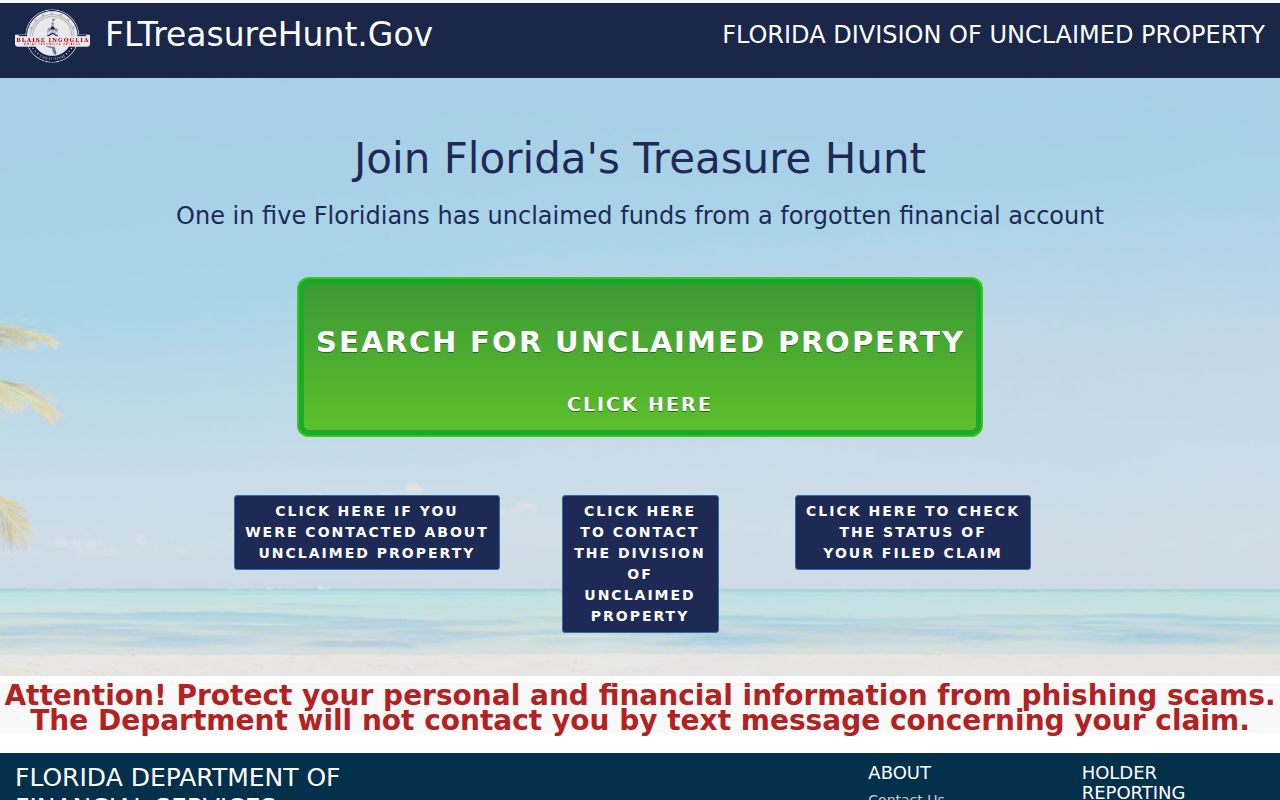
Using the official portal avoids paying an intermediary before a Cooper City claim is even checked.